Atlas of Lie Groups
and Representations
A project to classify the irreducible unitary representations of real reductive Lie groups — combining deep mathematics with computational methods to solve a fundamental open problem.
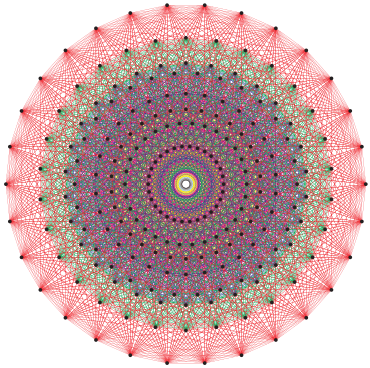
240 roots · rank 8 · dimension 248
We have computed Kazhdan–Lusztig polynomials for the split real form of E₈. The largest coefficient is 11,808,808. Read the details of the computation and David Vogan's narrative of the project.
A computational approach to the unitary dual problem
The Atlas project brings together mathematicians and software to tackle one of the central open problems in representation theory.
The Unitary Dual
For a real reductive Lie group G, classifying all irreducible unitary representations is a fundamental open problem. The Atlas project develops the mathematical theory and algorithms to make this classification tractable.
Software & Algorithms
The Atlas software implements algorithms for structure theory and admissible representations, computing Kazhdan–Lusztig–Vogan polynomials, character formulas, and signatures of invariant Hermitian forms.
Workshops & Papers
The project runs regular workshops bringing together researchers in representation theory. Notes from the Palo Alto workshops and other proceedings are freely available alongside preprints and expository material.
Interactive Tools
Interactive web tools make parts of the theory accessible: explore spherical unitary representations, visualize root systems, and browse tables of computed data for classical and exceptional groups.
Explore the Atlas
Software
Download and install the Atlas software. Includes documentation, examples, and mathematical background.
Download →Papers & Notes
Research papers, workshop notes, and expository material on the mathematics underlying the Atlas project.
Browse papers →Documentation
Full software documentation: command reference, tutorials, the Axis language, and built-in function index.
Read docs →Workshops
Past and upcoming Atlas workshops. Notes and resources from previous meetings available for download.
View workshops →People
Mathematicians from institutions across North America and Europe working on the Atlas project.
Meet the team →Spherical Unitary Explorer
Interactive tool for exploring spherical unitary representations of classical groups.
Open tool →Kazhdan–Lusztig polynomials
for E₈
One of the landmark achievements of the Atlas project is the computation of all Kazhdan–Lusztig–Vogan polynomials for the split real form of E₈, the largest exceptional Lie group.
This required computing a 453,060 × 453,060 matrix and took 77 hours on a 64-core machine with 64 GB of RAM. Announced in 2007, it attracted widespread attention as a landmark in computational mathematics.